Ethics & Morals – Time to clear the confusion
The Vedas (Knowledge) – It’s Function & Structure
The Vedas (Knowledge) are principally divided into three portions – Mantra, Brahmana and Aranyaka. They are beginningless (Anadi), infinite (Ananta) and not the creation of the humans (Apaurusheya). A unique feature of the Vedas is that they have no internal contradictions. The portion now available is a very small part of the original and so very valuable.
Vast portions of this text have been lost in antiquity.
Vedas (Knowledge) are the means of gaining more knowledge through – Pramana (Acceptable Proof) for Dharma andBrahman.
Brahman (God) = The Original Cause of All Causes!
Dharma (Good) = The way “It originally was & Is” … and hence the crucial need to maintain it be so, for the happiness of all.
Pramanas are of six in number. They are:
1. Pratyaksha (Visible) pramana: Direct perception i.e. through our senses we gain the knowledge of the world.
2. Anuman (Imagination) pramana: We infer what we don’t see from what we see. We know the relationship of what we see with what we don’t see. Like we see smoke and infer fire.
3. Upamana (Comparison) pramana: We learn through comparison. We see an object, which is similar to what we had seen before and by comparison we come to know the new object. For example we compare the materials found on Mars with that on Earth and learn.
4. Arthapatti (Result) pramana: Knowledge is gained of the cause by studying the effect. This too is a type of inference. We see that the roads are wet and infer the cause as rain.
5. Anupalabdhi (Unavailable) pramana: When we do not see a thing which we know at a place we gain knowledge of it’s absence. Like, we know human & animal life is absent on the moon. This too depends on pratyaksha.
6. Agama (Scriptures) pramana: We gain knowledge of Dharma and Brahman, which are beyond the domain of our senses, from the Vedas. Hence Vedas are Aagama Pramana also known as Shabda (Spoken Sound) Pramana. Read the rest of this entry
Economics & Religion
Drugs and Medicines
I am Karl Loren (Founder of Vibrant Life, CA-USA & www.oralchelation.com) Below is one of my favorite articles authored by my earlier partner in India, Mr. MSR Ayyangar (Chairman & Managing Director of Emmessar Technologies Ltd, MUMBAI – INDIA) that explains in a very simple a way – the difference between drugs and medicines. I have passed this around to many as I learned so much from it. It is extremely enlightening to one and all … please carefully read below …..
Quote: Article of MSR Ayyangar, MUMBAI, INDIA.
You may have been consuming drugs for health – but getting sickly more and more? Did you ever think why? Drugs don’t cure! Do you know that? They only relieve or control..! Medicines alone help cure! Actually Body & Mind can completely cure themselves with the right kind of help. Do you know the actual difference between a drug and a medicine? Contrary to the normal belief that they are synonyms (same) – they are actually antonyms (opposite). Drugs take away control of your body & mind from You! Medicines reverse this and restore the control back to You!
Let me elaborately clarify here how it is so … Read the rest of this entry
Science and Spirituality – Ananda & Multicellular Organisms
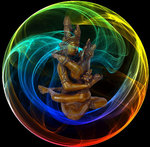 DEEPAK M RANADE likens the Shiva-Shakti conjugal union of ananda or bliss to that of quantum coherence or zero entropy.
All Creation Is Energy
All creation is energy, manifesting in different forms. As postulated by Albert Einstein in his famous E=mc2 equation, and later verified under rather tragic circumstances, mass and energy are inter-convertible. Energy and matter, however, display a conjugal relationship. Energy excites matter, and increases its disorder or entropy.
Measuring Chaos
Entropy is the measure of the disorder, randomness or chaos in a given system. As we heat water, the molecules get agitated and after a point, the water begins to boil. Heat or thermal energy increases the entropy of water, and further heating causes the water to change its state and evaporate. The tendency to disseminate and equilibrate matter and energy across the entire universe is the basis of entropy.
From Order To Disorder And Back
The entropy of the universe is ever increasing with time. That’s a universally
accepted and proven law. Time is a programme that travels uni-directionally, from order to disorder. Logic, however, demands that the reverse journey, namely from disorder to order, must also exist. When we tidy up our room that was in disarray, we are taking this very path. Information systems are another example of decreasing entropy. The greater the information about a system, there is likely to be less chaos and disorder. DNA represents a highly complex code of information. It precisely determines the structure and function of the organism in a very orderly and structured manner. Read the rest of this entry


 MSR Ayyangar's Blog